The Gates of Hell and a Glass of Wine: A Guide to Turkmenistan's Most Unusual Stops
 Tipple Tours
Burning craters, dinosaur footprints, underground lakes and enough bizarre monuments to make Las Vegas look like a modest village in Norfolk.
There are normal holidays, unusual holidays and then there's Turkmenistan, a country where you can stand beside a gigantic burning hole in the desert, admire a golden statue of a horse and visit a city that appears to have been built entirely from the contents of an extremely expensive bathroom showroom. It's the sort of destination that makes you wonder whether somebody has accidentally handed the country's tourism department a science-fiction script.
Welcome to one of Central Asia's strangest and least-visited countries, where the landscapes are extraordinary, the history is fascinating and the tourist attractions occasionally sound as though they've been invented by someone who's had three glasses of wine and lost access to adult supervision. There's a flaming gas crater nicknamed the Gates of Hell, ancient cities swallowed by sand, mountains filled with dinosaur footprints and an underground lake that looks like a Bond villain's secret swimming pool.
At Tipple Tours, we believe a great holiday should involve excellent company, unusual experiences and at least one moment when you turn to the person beside you and ask, “Are we actually allowed to be here?” Turkmenistan delivers all three, although we'd strongly recommend checking the local rules before asking that final question too loudly.
1. The Gates of Hell: Turkmenistan's Most Spectacular Planning Disaster
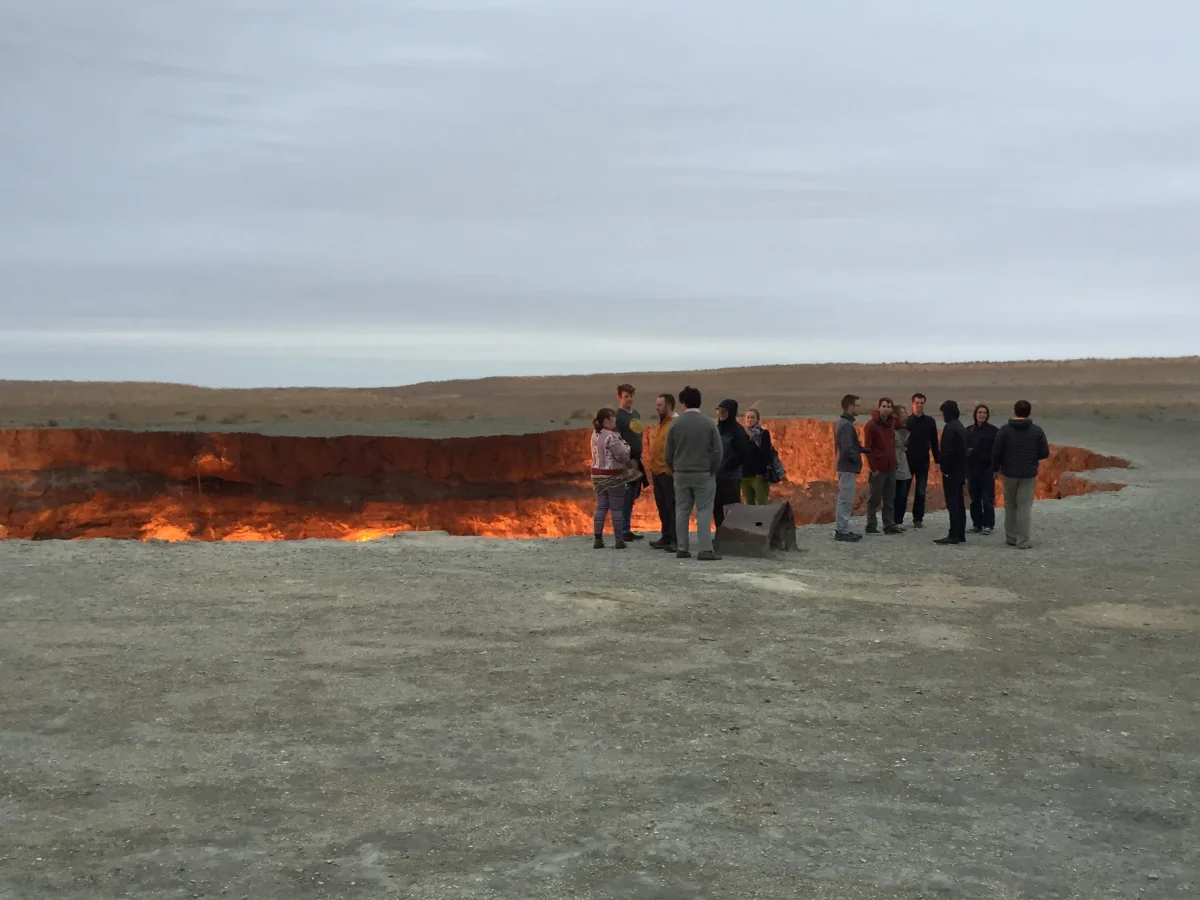
Imagine you're standing in the middle of the Karakum Desert. It's dark, the stars are out and somewhere in front of you is a gigantic hole in the ground filled with flames. Not a small campfire, not a particularly enthusiastic barbecue, but an enormous burning crater that looks as though somebody has accidentally removed the lid from the Earth's central heating system.
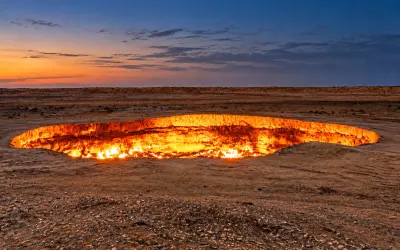
Welcome to the Darvaza Gas Crater, better known as the Gates of Hell, one of Turkmenistan's most extraordinary attractions. The crater is roughly 70 metres across and became famous for the flames burning within it for decades. The popular story claims Soviet drilling operations caused the ground to collapse and that escaping gas was deliberately ignited to prevent it spreading. The precise origins and date remain disputed, which somehow makes the whole thing even more wonderfully mysterious.
For years, the crater was one of the world's most unlikely tourist attractions. People travelled across vast stretches of desert to stand beside an industrial accident that nobody had quite managed to switch off. Imagine explaining that to your travel insurance company: “Purpose of trip? To admire a large burning hole. No, it's not a metaphor. Yes, we're paying to see it.”
The crater's flames have diminished significantly following efforts to reduce the escaping gas, so visitors shouldn't assume they'll encounter the enormous inferno shown in older photographs. Nevertheless, Darvaza remains an extraordinary location, particularly for anyone fascinated by strange landscapes and the rather spectacular consequences of human engineering.
And what better way to contemplate several decades of questionable industrial decision-making than with a glass of wine back at your desert camp? Preferably a red, although you might want to keep it away from anything still on fire.
2. Ashgabat: The Capital That Ordered Marble by the Continent
Most capital cities develop gradually over centuries, collecting historic buildings, charming streets and the occasional hideous shopping centre. Ashgabat appears to have taken a different approach: order several mountains' worth of white marble, construct enormous monuments and make absolutely certain nobody mistakes the place for somewhere ordinary.
Turkmenistan's capital earned a Guinness World Records title in 2013 for its extraordinary concentration of white marble-clad buildings. Government offices, hotels, apartment blocks and public buildings gleam beneath the desert sun, often accompanied by elaborate fountains, immaculate gardens and enormous golden statues. The overall effect resembles a futuristic capital designed by somebody who had unlimited funding and had recently discovered the architectural possibilities of bathroom tiles.
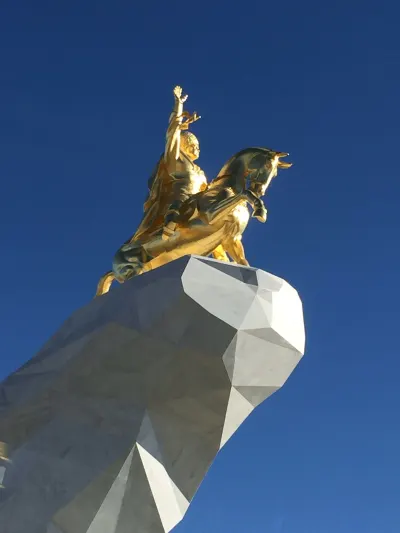
Then there are the monuments. Ashgabat boasts an enormous Wedding Palace featuring a giant globe, a Monument of Neutrality topped with a golden former president and statues celebrating the country's beloved Akhal-Teke horses. Some ceremonial districts can appear remarkably quiet, giving the unsettling impression that you've arrived on the set of a blockbuster film before the extras have turned up.
Of course, beyond the grand architecture is a real city with markets, neighbourhoods and everyday life. But Ashgabat's most memorable quality is its extraordinary appearance. After a day exploring, you'll probably find yourself ordering a drink and asking whether the entire experience actually happened or whether somebody slipped something unusual into your afternoon tea.
3. Kow Ata: The Underground Lake That Looks Like a Bond Villain's Spa
Just when you think Turkmenistan can't get any stranger, somebody suggests going for a swim in a cave. Not a pleasant little rock pool with a nearby café, but a vast underground chamber containing naturally warm, mineral-rich water reached by descending a long staircase into the earth.
Welcome to Kow Ata, often translated as Father of Caves, an underground lake near the village of Bäherden. The water is naturally warm, typically around 33–37°C, and the cave has long attracted visitors interested in its mineral waters. The atmosphere is extraordinary, with dim lighting, towering rock walls and the slightly unsettling sensation that you're about to stumble upon the secret headquarters of an international criminal organisation.
Descending the steps is part of the adventure, although the return journey is less glamorous. After enjoying a relaxing swim, you'll have to climb back towards daylight, which is an excellent opportunity to discover muscles you haven't used since school sports day. It's essentially a spa experience combined with an unexpected fitness assessment.
Access and bathing arrangements can change, so it's worth checking with your local guide before visiting. But if the lake is open, it's certainly one of the more unusual places to take a dip. Most people return from holiday boasting about an infinity pool overlooking the Mediterranean. You can tell everyone you went swimming beneath Turkmenistan and emerged looking slightly confused but thoroughly refreshed.
4. The Dinosaur Plateau: Jurassic Park Without the Gift Shop
Deep in the remote Köýtendag Mountains of eastern Turkmenistan lies one of the country's most remarkable natural attractions: a vast area of ancient dinosaur footprints preserved in rock. The site, commonly known as the Dinosaur Plateau, contains numerous fossilised tracks dating back roughly 150 million years, offering an extraordinary glimpse into a time when enormous prehistoric creatures wandered across what is now Central Asia.
It's a genuinely fascinating place, particularly when you consider that you're standing on a surface once crossed by dinosaurs long before anyone had invented passports, hotel minibars or the concept of paying £9 for a small glass of wine. Some tracks form recognisable trails, allowing visitors to imagine the creatures moving across an ancient landscape that looked very different from today's rugged mountains.
Naturally, at Tipple Tours we'd have a few questions. Were these dinosaurs travelling in groups? Did one of them insist on stopping every five minutes for photographs? And was there a particularly irritating dinosaur at the back who kept asking whether they were nearly there yet?
The plateau is remote and requires careful planning, suitable transport and local guidance. But for travellers who enjoy genuinely unusual experiences, walking among dinosaur footprints in a country most people struggle to locate on a map is difficult to beat. Just don't expect a visitor centre selling inflatable Tyrannosaurus rexes and overpriced cappuccinos.
5. Yangykala Canyon: The Grand Canyon's Less Famous, More Mysterious Cousin
Turkmenistan's Yangykala Canyon is one of those places that makes you wonder why the country isn't permanently featured on the front cover of travel magazines. Its dramatic cliffs, layered rock formations and extraordinary colours create a landscape that looks as though somebody has taken the Grand Canyon, added several shades of pink and orange and then forgotten to tell the rest of the world about it.
The name Yangykala is commonly translated as Fire Fortresses, which is considerably more exciting than the names most British geographical features receive. Imagine if the Yorkshire Dales had been marketed as the Flaming Kingdom of Limestone. Tourism would probably have doubled overnight.
The canyons are particularly impressive in changing light, when the colours shift across the cliffs and the surrounding desert stretches towards the horizon. It's a magnificent place for photography, although the remote location means you'll need appropriate transport, supplies and an experienced guide. This isn't somewhere you want to discover that your hire car has a flat tyre and your mobile phone has decided to take the afternoon off.
For the full Tipple Tours experience, imagine ending the day somewhere safe with a glass of wine, watching the colours change across the landscape while trying to remember how you ended up in one of Central Asia's most spectacular and least-known natural wonders. It's certainly a better story than spending another afternoon arguing over sun loungers in Tenerife.
6. Merv: The Ancient City That Had a Very Bad Day
Long before Turkmenistan became famous for marble monuments and burning gas craters, it was home to one of the great cities of the ancient Silk Road. Merv was once a major centre of trade, culture and learning, attracting merchants, scholars and travellers from across Asia and beyond.
At its height, Merv was among the most important urban centres in the region, with impressive fortifications, religious buildings and bustling markets. Then, in 1221, Mongol forces arrived and the city suffered a devastating conquest. The precise death toll is impossible to establish, but the destruction became one of the most notorious episodes in the region's medieval history.
Today, the archaeological remains of Ancient Merv form a UNESCO World Heritage Site, with mud-brick walls, mausoleums and the remnants of successive settlements scattered across an enormous area. It's a fascinating place to explore, especially when you consider how much history lies beneath the apparently empty landscape.
And while Merv's story is undeniably dramatic, there's something particularly extraordinary about standing among the ruins of a once-great Silk Road city, imagining the merchants, caravans and travellers who passed through centuries ago. They probably complained about accommodation prices, unreliable transport and the quality of the local wine too. Some aspects of travel never change.
7. Nisa: Where the Parthians Built a Fortress and Forgot to Leave Instructions
Just outside Ashgabat lies Old Nisa, an ancient archaeological site associated with the Parthian Empire. The Parthians were once a formidable regional power, challenging Rome and controlling important trade routes across the ancient world. They were particularly skilled horsemen and archers, which probably made them considerably less pleasant to encounter in battle than your average modern sightseeing group.
The remains of Nisa include ancient walls, ceremonial structures and archaeological discoveries that have helped historians understand this important civilisation. Today, the site is a UNESCO World Heritage Site, offering a remarkable contrast to the polished marble extravagance of modern Ashgabat.
One minute you're exploring the remains of an ancient empire and contemplating thousands of years of history. The next you're back in a capital where someone has decided that an enormous golden horse would make an excellent roundabout decoration. It's quite an architectural journey, and one that perfectly captures Turkmenistan's ability to jump between the ancient and the completely unexpected.
8. The Karakum Desert: Where the Nearest Pub Is Probably 200 Miles Away
The Karakum Desert covers much of Turkmenistan and provides some of the country's most memorable scenery. Vast sandy landscapes, remote settlements and seemingly endless horizons create an atmosphere that feels wonderfully removed from modern life, especially once you've travelled far enough to lose reliable mobile reception.
Desert journeys can involve long drives across isolated terrain, encounters with camels and opportunities to experience the hospitality of local communities. Depending on your itinerary, you might stay in a desert camp, enjoy a traditional meal or simply sit beneath an extraordinary night sky contemplating how many stars exist when there aren't several thousand streetlights competing for attention.
Naturally, a desert adventure requires sensible planning. Water, suitable clothing, reliable transport and experienced local guides are essential, while temperatures can vary dramatically between day and night. This is not the place to announce that you've decided to go for a spontaneous three-hour stroll because you've spotted something interesting on the horizon.
But there's something magical about spending time in such an enormous, quiet landscape. After the gleaming marble of Ashgabat and the extraordinary geological attractions elsewhere in the country, the desert offers a different kind of spectacle. No enormous golden statues, no futuristic wedding palaces and very few opportunities to buy an emergency packet of crisps.
Just sand, silence and the growing suspicion that you've travelled somewhere genuinely extraordinary.
9. The Turkmenbashi Seaside: A Beach Holiday with a Slight Identity Crisis
You probably don't associate Turkmenistan with seaside resorts, but the country has a coastline along the Caspian Sea and an ambitious resort development known as Awaza, near the city of Turkmenbashi. Here you'll find large hotels, landscaped promenades and resort infrastructure that creates yet another surprising contrast with the country's remote deserts and ancient ruins.
Awaza was developed as a major tourism destination, although visitor numbers and the atmosphere can be very different from established Mediterranean resorts. Depending on when you visit, some areas may feel remarkably quiet, with impressive hotel buildings and broad promenades that seem to be patiently waiting for several coachloads of holidaymakers to appear.
It's a fascinating example of Turkmenistan's enthusiasm for grand projects. Imagine someone deciding to build a major seaside resort and then remembering that international tourism is heavily restricted. The result is an unusual destination that feels rather different from Benidorm, although the absence of stag parties dressed as inflatable bananas might be considered a significant advantage.
The Caspian coast also provides an opportunity to see another side of the country, with maritime landscapes, regional cuisine and a very different atmosphere from the desert interior. Just don't arrive expecting a traditional British seaside experience. You're unlikely to find a pier selling candyfloss, a penny arcade or a man shouting about donkey rides.
10. The Final Mystery: Why Isn't Everyone Visiting Turkmenistan?
After exploring burning craters, marble cities, underground lakes, dinosaur footprints and ancient Silk Road ruins, you might reasonably wonder why Turkmenistan isn't one of the world's most popular adventure destinations. The answer has rather less to do with its attractions and considerably more to do with the practical difficulties of visiting.
Turkmenistan is one of the world's most tightly controlled countries, with restrictions on independent travel, photography, internet access and movement. Visa requirements and travel arrangements can be complicated, and many visitors rely on licensed local operators to organise their journeys. It's not the sort of place where you can casually book a flight on Friday and spend Saturday wandering around with a guidebook and a vague sense of optimism.
But for travellers willing to plan carefully and approach the country with an open mind, Turkmenistan offers an extraordinary collection of experiences. Few destinations combine such remarkable natural landscapes, ancient history and surreal modern architecture within a single journey.
And that's what makes it so appealing to people who prefer their holidays a little less predictable. You might arrive expecting a burning hole in the desert and leave talking about underground swimming pools, ancient empires, giant golden horses and the strange experience of driving through a capital where every building appears to have been polished that morning.
Is Turkmenistan Worth Visiting?
If your ideal holiday involves predictable sightseeing, familiar restaurant chains and a hotel where the biggest surprise is discovering the breakfast buffet has run out of croissants, Turkmenistan might not be your natural habitat. But if you enjoy unusual destinations, fascinating history, extraordinary landscapes and experiences that leave you struggling to explain what you've just witnessed, it deserves serious consideration.
At Tipple Tours, we've always believed that the best travel stories rarely begin with “We spent five days doing exactly what everyone else does.” They begin with something more interesting, such as “So there we were, standing beside a gigantic burning crater in the middle of Turkmenistan, wondering whether anyone had remembered to bring the corkscrew.”
And while Turkmenistan isn't famous for its wine, we'd argue that there's something rather wonderful about ending an extraordinary day with a glass of something decent, a few new friends and the realisation that you've just visited somewhere most people couldn't even point to on a map.
Small groups. Big pours. And occasionally, a gigantic hole in the ground that really should have come with a warning sign.
Explore Related Tours
Turn This Story Into Your Adventure
Editorial Team
The Tipple Tours team writes about wine, beer, and travel based on firsthand experience running tours across Europe since 2018.
Learn more about usContinue Exploring
More Stories You'll Love
 🗺️ Destination Guides
Ashgabat's Marble City: What to Expect in Turkmenistan's Strangest Capital
Welcome to Ashgabat, where 543 marble-clad buildings, giant golden horses, suspiciously empty streets and a wedding palace shaped like a globe suggest someone gave a dictator unlimited funds and a very enthusiastic architect. Turkmenistan's capital is gloriously bonkers, dazzlingly white and possibly the world's most expensive bathroom showroom.
 🗺️ Destination Guides
I Went to North Korea Looking for Booze. Things Got Weird Surprisingly Quickly.
Most people visit North Korea for the history, politics or sheer curiosity. I went because I wanted to know what people were drinking. What followed involved local beer, unexpected meals and the realisation that even the world's most secretive country can surprise a wine merchant.
 🗺️ Destination Guides
25 Weird Things To Do In Transnistria: Europe's Most Fascinating Wrong Turn
Transnistria has Lenin statues, Soviet mosaics, rope ferries, giant bottle collections and a currency recognised by almost nobody. After years of exploring the region, I've come to one conclusion: it's either Europe's strangest destination or its most entertaining. Possibly both.
 🗺️ Destination Guides
Taiwan Beer, Whisky and Wine: A Beginner's Guide to the Island's Drinks
World-class whisky, tropical craft beers, surprisingly good wine and a local spirit strong enough to make a Scotsman reconsider his career choices. Welcome to Taiwan, where brewers put tea in beer, winemakers battle typhoons and the drinking culture is almost as wonderfully bonkers as the food.
 🗺️ Destination Guides
Can You Really Go on Holiday and Star in Your Own Movie?
Ever fancied becoming a movie star without the inconvenience of talent? Discover a holiday where you can drink Moldovan wine, battle zombie grandmothers and star in a horror film that Hollywood will desperately pretend doesn't exist.
 🗺️ Destination Guides
I Flew to Brazil for Three Days at Christmas and Discovered Copacabana Is Much Harder Work Than It Looks
I flew from Britain to Brazil for just three days at Christmas, spent most of Copacabana Beach trying to hold my stomach in, accidentally joined a volleyball game despite not playing since childhood and discovered that Brazilian beer is served at temperatures usually reserved for organ transplants. It may not have been sensible but it was unforgettable